What Valve Manufacturers Are Not Saying Publicly
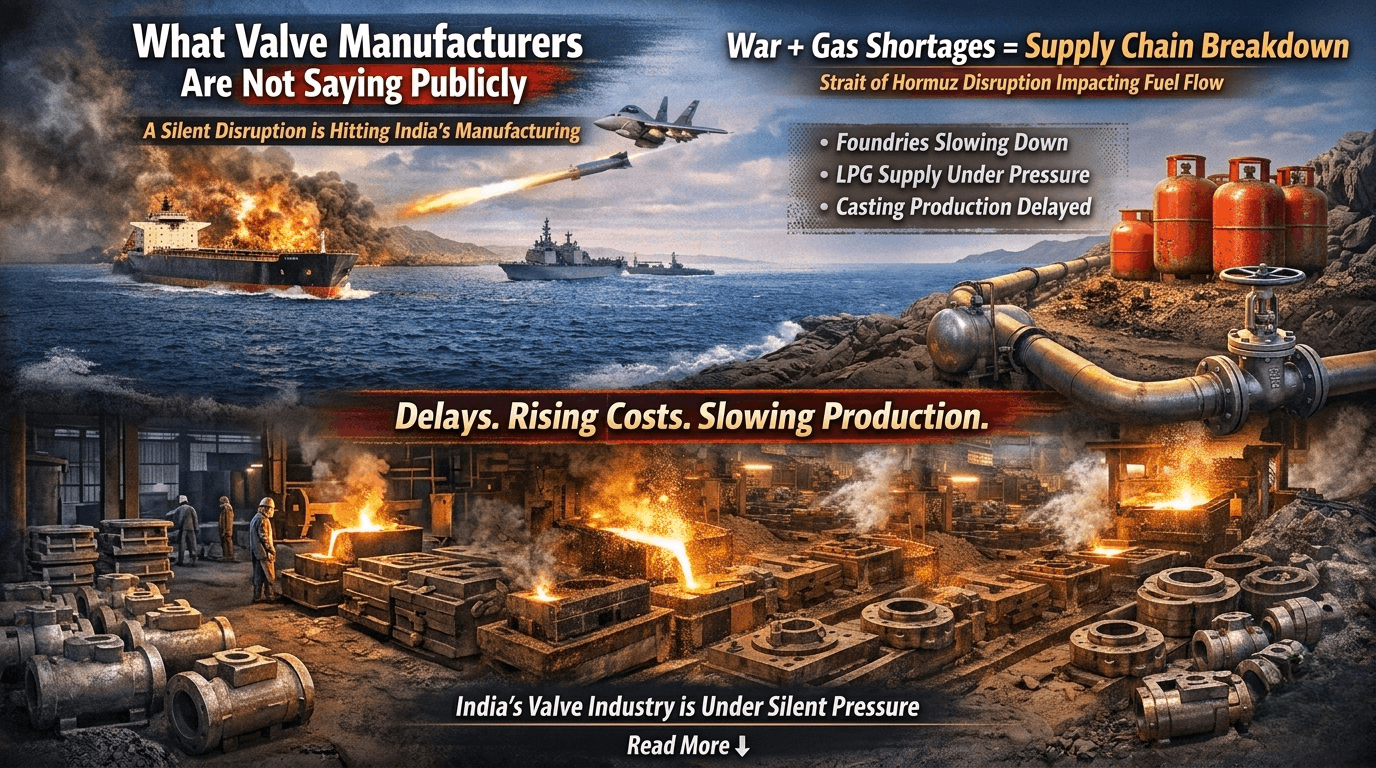
A quiet disruption is already building inside India’s valve and engineering manufacturing supply chain.
Casting production is slowing, delivery schedules are slipping, and manufacturers are quietly absorbing cost increases.
The underlying issue: industrial LPG and fuel gas shortages.
For those outside the industry, this may seem like a minor fuel supply issue. But anyone inside the valve, pump, and heavy engineering ecosystem knows that casting sits at the very base of the manufacturing pyramid.
India has over 5,000 foundries producing roughly 7.5 million tonnes of castings annually. Nearly every valve body and bonnet begins there.
Right now, some of the country’s most important casting clusters are under pressure.
Kolhapur (Maharashtra)
- ~300 foundries
- ~600,000 tonnes of castings annually
- A major supplier of engineering and industrial castings used across valve and pump manufacturing
Coimbatore (Tamil Nadu)
- ~600 foundry units
- One of India’s largest ecosystems producing castings for pumps, valves, and engineering equipment
Pune – Pimpri-Chinchwad industrial belt
- Thousands of MSME engineering units that depend on casting supply chains and heat-intensive processes
- Many units are already reporting production slowdowns due to restricted gas supply
The operational impact is very real.
Foundries rely on continuous high-temperature furnaces. When industrial LPG supply becomes uncertain:
- Furnaces cannot run at full heat load
- Melting cycles get interrupted
- Casting batches are delayed
- Production schedules slip across the supply chain
As a result, casting deliveries are already getting delayed, which is slowing machining, assembly, and final valve manufacturing timelines.
There is also a clear cost impact.
Across several suppliers, manufacturers are already seeing 20–25% increases in casting production costs, driven by fuel shortages, unstable furnace cycles, and reduced operating efficiency.
Many valve manufacturers are absorbing these increases quietly while managing production delays.
But if the situation persists, the effects will inevitably move downstream:
- Higher valve prices
- Longer project delivery timelines
- Supply chain bottlenecks across engineering sectors
- Casting disruptions rarely stay contained.
When foundries slow down, entire manufacturing ecosystems feel the impact.
KFEL Perspective
At Khimji Flow Equipments Pvt. Ltd. (KFEL), we recognize the challenges currently affecting the casting ecosystem.
Our approach has always been built on long-term supplier relationships, process stability, and proactive planning — allowing us to navigate such disruptions more effectively.
While the broader industry adjusts to ongoing changes, KFEL remains committed to maintaining reliable delivery timelines and consistent product quality for our clients.